← Blog  /  Buyer's Guide

Paper Cone Dimensions Explained: A Buyer's Specification Checklist

Jafar Iqbal Bhuiyan  ·  2026-07-25 Buyer's Guide

Paper cone dimensions are not a single number — they are five interdependent measurements that determine whether a cone seats correctly on your winding machine, holds its package shape, and runs a full shift without generating stoppages. Getting one dimension wrong rarely causes an obvious failure at goods-in inspection; it shows up later, on the winding floor, as vibration, slippage, or a cone that will not doff cleanly.

This guide covers the five dimensions that matter — length, taper angle, nose diameter, base diameter, and wall thickness — what each one controls on the mill floor, a comparison across common autoconer models, and a buyer's checklist to run before you place an order.

Buyer Takeaway

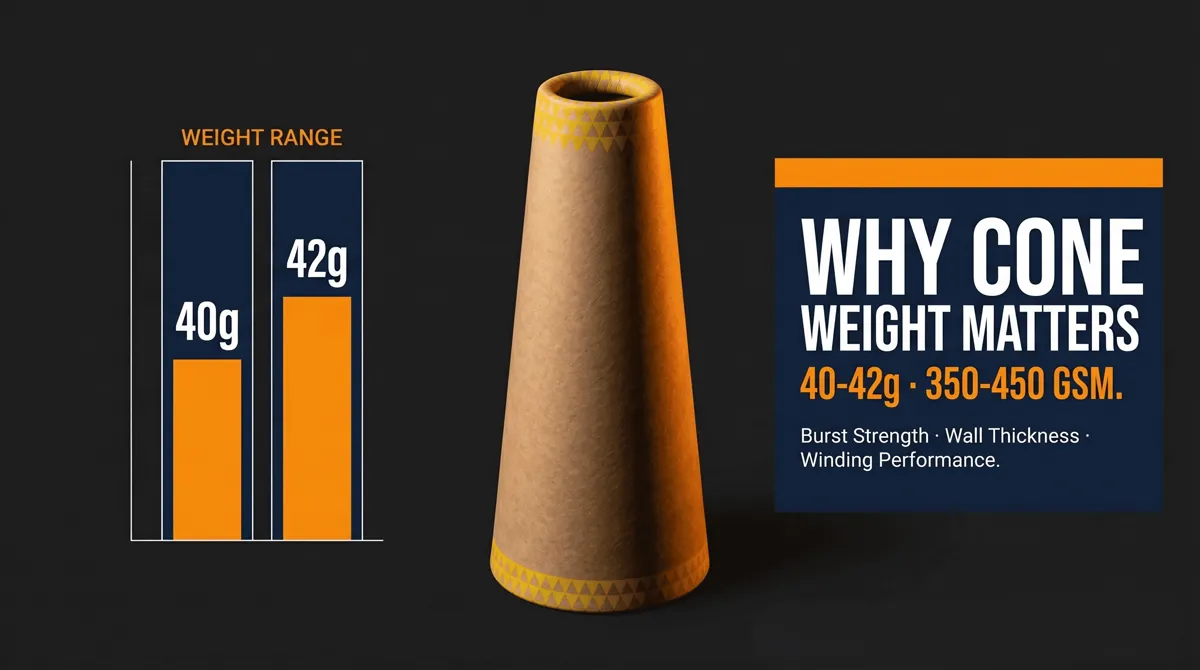
Confirm five dimensions before ordering: taper angle (4°20′ or 5°57′), length (170–173mm), nose inner diameter (27–28.5mm), base inner diameter (57.5–68.5mm depending on taper), and cone weight (40–42g at 350–450 GSM) as the wall-thickness proxy. Request the batch quality certificate with measured values, not just the specification target — a cone at the edge of tolerance behaves differently on the spindle cradle than one at the centre of the range.

Length: 170–173mm

Cone length — sometimes called height — determines package capacity: how much yarn the finished package holds before it needs doffing. The industry standard for auto-machine paper cones is 170mm, with 173mm used on machines configured for a larger finished package diameter. Schlafhorst Autoconer X5/X6 and some Savio Orion/Polar installations can be configured to run either length depending on the package setting on the machine — confirm your cradle configuration before ordering, since a cone outside the ±1mm tolerance will cause cradle fit problems. See our full paper cone specifications for the complete dimensional range.

Taper Angle: 4°20′ or 5°57′

The taper angle is the single specification that determines whether a cone seats on the spindle cradle at all. It is not a minor variation — 4°20′ and 5°57′ cones are not interchangeable on the same machine. 5°57′ is the standard angle for high-speed autoconers, including Schlafhorst X5/X6, Murata QPRO, and Savio Orion/Polar/Espero. 4°20′ is used on TFO twisters, doubling machines, and select autoconer configurations. Ordering the wrong angle produces a cone that either will not seat correctly or seats loosely enough to vibrate at winding speed.

Nose Inner Diameter: 27–28.5mm

The nose is the small end of the cone — the point where it contacts the spindle tip or winding head during automatic insertion. This is the dimension that controls cone seating. Nose ID runs 27.5–28.5mm on 4°20′ cones and 27–28.5mm on 5°57′ cones, held to a tolerance of ±0.25mm. A nose outside this tolerance either grips too tightly during automatic insertion — risking cracking — or seats too loosely, generating vibration at high RPM. On pneumatic insertion systems such as the Schlafhorst Autoconer, a nose ID outside tolerance causes mis-insertion and cone ejection rather than a smooth load.

Base Inner Diameter: 57.5–68.5mm (Depending on Taper)

The base is the large end of the cone and determines how the finished package sits in downstream handling — creels, transport cartons, and automated package transfer systems on machines such as the Schlafhorst Bobbin Cloud. Base ID runs 57.5–58.5mm on 4°20′ cones and 67.5–68.5mm on 5°57′ cones — the wider base on the 5°57′ specification is a direct consequence of the steeper taper angle over the same 170mm height. Within-batch base ID consistency matters as much as hitting the target range: inconsistent base diameters produce finished packages of varying diameter, which can trigger failures on automated package transfer lines further downstream.

Wall Thickness: Controlled by Weight and GSM, Not a Fixed Measurement

Paper cones are not specified by a raw wall-thickness figure in millimetres. Wall thickness is controlled indirectly through two parameters: cone weight (40–42g) and paper grade (350–450 GSM kraft). A 42g cone at 450 GSM has a measurably thicker, stiffer wall than a 40g cone at 350 GSM — the difference shows up as burst strength under winding tension, not as a number you can check with a caliper. For standard ring-spun cotton at moderate speed, the lower end of both ranges is adequate; for compact-spun, fine-count, or synthetic yarn at high winding speed, specify toward the upper end.

Dimension Comparison by Autoconer Model

Different autoconer families run different combinations of these dimensions, though most cluster around the same two standard specifications. The table below summarises the standard configuration for the machine platforms most commonly installed in spinning mills.

Machine / ModelTaper AngleLengthNose IDBase IDNotch Type
Schlafhorst Autoconer 338 / X5 / X65°57′170mm (173mm on X5/X6)27–28.5mm67.5–68.5mmV-notch (338); Y-notch standard (X5/X6)
Savio Orion / Polar / Espero5°57′170mm (173mm on some Orion/Polar)27–28.5mm67.5–68.5mmV-notch standard (Polar: V or Y)
Murata QPRO / Process Coner4°20′ or 5°57′ (configuration-dependent)170–173mm27–28.5mm or 27.5–28.5mm (per taper)67.5–68.5mm or 57.5–58.5mm (per taper)V-notch required
TFO twisters / doubling machines4°20′170–173mm27.5–28.5mm57.5–58.5mmPer machine auto-doffer configuration

Machine variants and package settings differ within each family — always confirm against your specific machine documentation rather than the model name alone. For a deeper look at how dimensional mismatches show up as production faults, see our common paper cone problems guide.

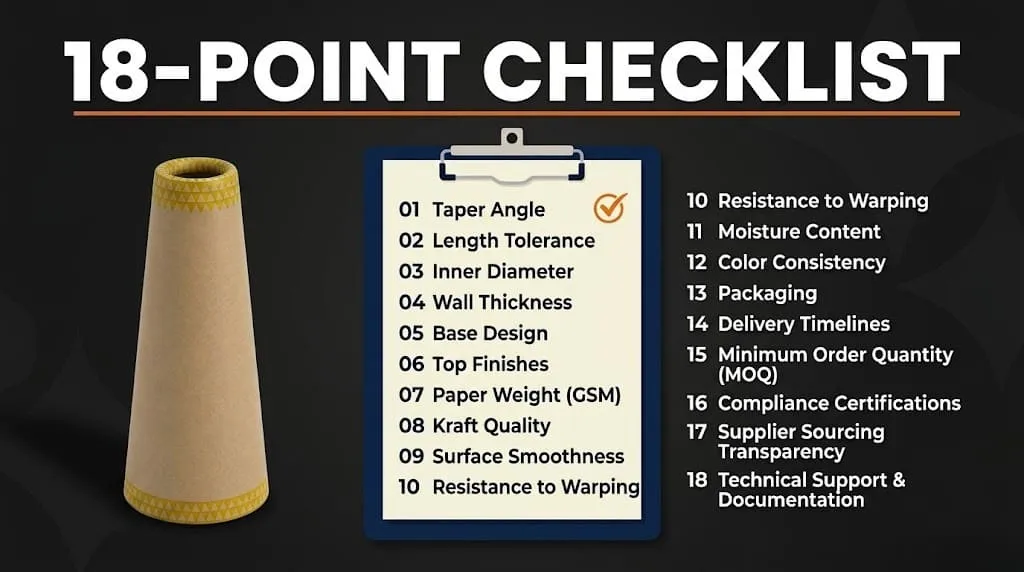
Buyer's Checklist: Dimensions to Verify Before Ordering

  1. Taper angle — 4°20′ or 5°57′, confirmed against your machine's technical manual, not assumed from the model name.
  2. Cone length — 170mm or 173mm, matched to your machine's package capacity setting.
  3. Nose inner diameter — within the 27–28.5mm range (taper-dependent), with stated tolerance.
  4. Base inner diameter — within the 57.5–68.5mm range (taper-dependent), with stated tolerance.
  5. Cone weight — 40–42g, confirmed as a measured batch value, not just the specification target.
  6. Paper grade (GSM) — 350–450 GSM kraft, matched to your winding speed and yarn type.
  7. Notch type — V-notch or Y-notch, matched to your auto-doffer configuration.
  8. Surface finish — smooth, velvet, or embossed, matched to yarn fibre type.
  9. Dimensional tolerance — stated explicitly on the proforma invoice, not left as "standard".
  10. Batch quality certificate — measured values from the actual production batch, not the specification sheet alone.

Confirm every dimension in writing before production starts. Two cones that look identical on a spec sheet — same length, same weight, same price — can differ enough on taper angle or nose diameter to produce completely different results on the winding floor. Our paper cones for yarn winding and paper cone for spinning mills pages list the full standard ranges referenced throughout this checklist.

Need exact dimensions for your winder model? Send us your machine details on WhatsApp — we'll confirm compatible cone specs within 24 hours.

Related Guides

Looking for a reliable paper cone supplier?

Aziz Packaging Limited manufactures kraft paper yarn cones — 4°20′ and 5°57′ tapers, smooth, velvet and embossed finishes — for spinning mills. Based in Narayanganj, Bangladesh. Export-ready on FOB terms.

See our paper cones for yarn winding →

Need Precision Paper Cones?

Aziz Packaging Ltd. supplies yarn winding cones to textile mills in 50+ countries.

Get a Free Quote →
Get a Quote