For product and order context, see our paper cones for spinning mills. Use this guide to prepare requirements for review; final acceptance follows your approved drawing and mill trial.
Start with the holder and approved cone drawing
4°20′ and 5°57′ describe different taper families. Neither is universally correct for a machine brand. Identify the exact winding model, holder and spindle-seat requirements. Use the manufacturer's manual or the mill's approved cone drawing and verify any uncertainty before selecting a sample.
Why the wrong taper doesn't just fit loosely — it fails a specific way
A cone built to the wrong taper for a given holder doesn't simply seat imperfectly; it fails in a way specific to which direction the mismatch runs. A cone with a narrower taper than the holder expects tends to seat too deep and grip too tightly on the spindle, which can cause difficulty during automatic insertion or removal, and localized stress at the nose during doffing. A cone with a wider taper than expected seats too shallow, seating loosely enough to vibrate at running speed — this shows up as package instability, uneven layer build, or intermittent stops at the clearer rather than as an obvious immediate mis-seat. Knowing which failure pattern you're seeing on the floor is itself a diagnostic clue pointing back to which direction the taper mismatch runs, before you even remeasure the cone.
Read the notation correctly
4°20′ means four degrees and twenty minutes, approximately 4.333 degrees. It is not decimal 4.20°. Likewise, 5°57′ is 5.95 degrees, not 5.57°. If a purchase request uses a decimal-looking shorthand, confirm the intended designation rather than silently converting it. This confusion is common enough in purchase orders and email threads that it's worth reading back the degrees-and-minutes value explicitly in any written confirmation, rather than trusting a decimal abbreviation to survive being retyped by someone else down the supply chain.
A taper alone is not a specification
- State length, nose and base inner diameters with measurement positions — a diameter without a stated measurement point on the cone is ambiguous, since inner diameter changes continuously along a tapered cone's length.
- Add required wall thickness, outer diameters, rim and notch details.
- Agree tolerances and inspection methods against the drawing, including how many units per lot get measured and where.
- Specify finished cone weight and paper GSM separately — see our GSM vs finished weight guide for why these are two different figures, not one.
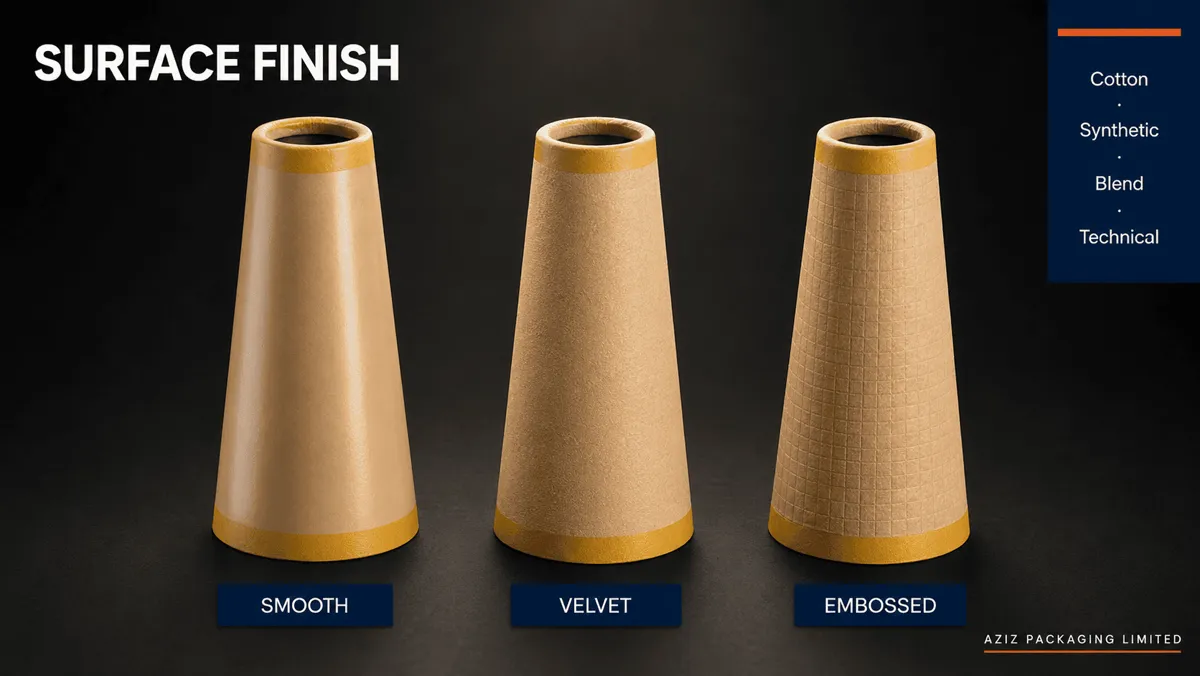
- Choose a proposed smooth, velvet or embossed finish for a yarn trial, matched to the yarn type actually running on the machine, not assumed from the taper alone.
Spinning equipment and winding equipment
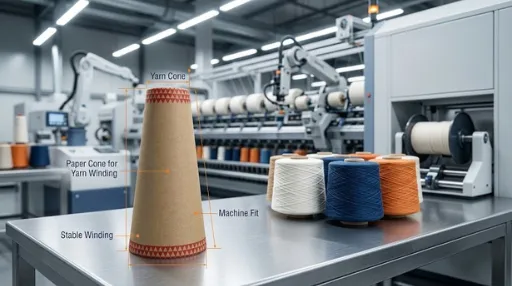
Muratec lists QPRO as an automatic winder and VORTEX as a spinning machine. VORTEX package requirements need their own model-specific review. See Muratec's machine history and our Murata matching guide. A spinning-frame name alone is not the specification for a downstream winder — the same spinning frame can feed different downstream winders across different mills, and it's the winder's holder that determines the cone taper, not the spinning frame upstream of it.
A practical order of operations for a new or uncertain machine
When the correct taper isn't already documented at your mill: first, locate the machine's own technical manual and check the spindle or bobbin specification section — this is the authoritative source, not a general assumption based on the brand name. Second, if the manual is unavailable, physically inspect a cone currently running successfully on that machine and note its taper directly, rather than guessing from the machine model number alone, since the same model family sometimes ships in more than one configuration. Third, before committing to a bulk order, request a small trial batch at the taper you've identified and run it through a full doff cycle on the actual machine — not just a static fit-check — since some seating problems only appear under running tension. Fourth, once a batch is confirmed correct, record the taper against that specific machine/holder combination in your own documentation, so the next reorder doesn't require re-deriving it from scratch.
Approve a trial and retain the reference
Check seating, starting grip, package build, doffing and unwinding on the intended setup. Record the yarn and machine settings with the result. Approve the sample or drawing revision and use it to review repeat lots. The measurement guide explains how to record the reference.
Send your exact winding-machine model, reference cone or drawing, taper, finish, quantity and destination through our sample and quotation form. Include any special inspection or packing requirement so it can be confirmed in writing.