For product and order context, see our paper cones for spinning mills. Use this guide to prepare requirements for review; final acceptance follows your approved drawing and mill trial.
GSM and cone weight are different measurements
GSM expresses the mass of paper per square metre. Finished cone weight is the mass of one empty cone after forming and finishing. The finished result also reflects cone dimensions, layer construction, adhesive, coating and condition. A GSM number cannot be substituted for a finished cone weight or used by itself to establish wall strength.
Why GSM alone doesn't predict wall strength
Two cones built from paper of the same GSM can behave differently under winding tension. Wall strength on a wound paper cone comes from several factors working together: how many plies of paper are laminated into the wall, how those plies are bonded (adhesive type and coverage, not just presence), the fibre furnish of the kraft paper itself, and how tightly the paper is wound and calendared during forming. A single-ply cone at a given GSM and a multi-ply cone built to the same finished weight can have meaningfully different burst resistance and crush behaviour, because the GSM figure describes the paper stock going in, not the engineered structure coming out. This is why a specification sheet that states only a GSM range, without also stating ply count and finished weight, doesn't tell you enough to predict how the cone performs on your machine.
What burst-strength testing actually checks, and how to ask for it
Burst strength (commonly assessed with a Mullen-type burst test) measures the pressure a paper sample can withstand before rupturing, applied perpendicular to the sheet. For a wound cone, this correlates with resistance to crushing in the carton and to localized stress at the nose and base during automatic insertion and doffing — but it is a paper-stock test, not a full-cone load test, so it tells you about the material, not the finished geometry. When comparing suppliers, ask specifically: which test method do they use, is it run on the flat paper stock or on a cut section of the formed cone wall, and do they report individual readings or only a pass/fail against an internal limit. A supplier that can answer all three specifically is giving you something you can actually compare; a supplier that just states a number without method is not.
Reading a quote that mentions 40–42 g or 350–450 GSM
These ranges have appeared in paper cone inquiries and earlier Aziz content. They are not a maintained, approved specification for every Aziz cone. Ask which finished weight and paper grade apply to your requested drawing, and confirm them on the proposed sample. Other requested weights, including 45 g, 46 g or 50 g, also need order-specific availability review.
Compare on the same basis
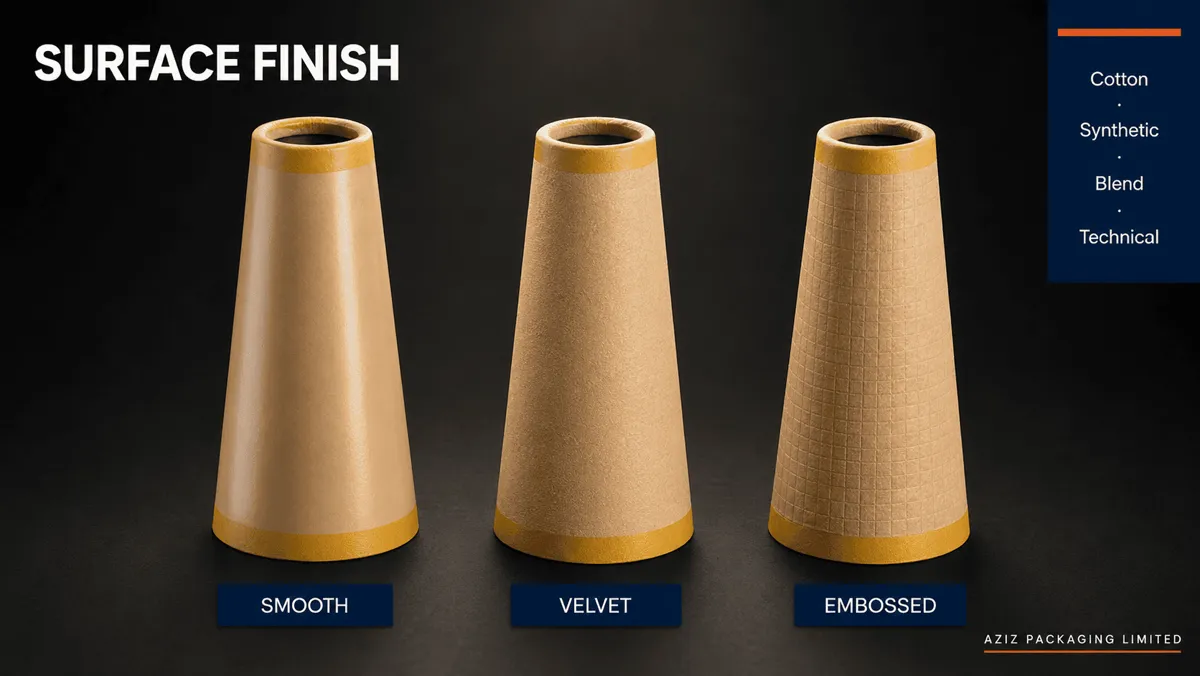
- Confirm the same taper, dimensions and finish before comparing weight. A heavier cone at a different taper or a different surface finish isn't a fair comparison — you're pricing two different products, not two versions of the same one.
- Ask for the paper grade and GSM specified for that construction, not a generic range pulled from a catalogue. A supplier who can state the exact grade for the exact drawing you sent is quoting on your spec, not a stock listing.
- Agree conditioning and weighing method with QC and record individual sample readings — paper is hygroscopic, so a cone weighed straight out of a humid warehouse will read heavier than the same cone conditioned to standard atmosphere first. If two quotes were weighed under different conditions, the numbers aren't comparable as given.
- Use a relevant, agreed strength test if the application needs it; a heavier cone alone does not prove better performance — see the burst-strength section above for what to actually ask for.
- Run the sample using representative yarn and winding settings before approving a specification. A cone that looks fine on the bench can still underperform at your actual winding speed and yarn tension; the only real test is a trial on your own machine.
What happens when weight or GSM drift from the approved drawing
A cone lighter than the approved sample, at the same dimensions, generally means a thinner or less densely bonded wall — the practical risk is deformation under winding tension, package instability, or crushing in transit that wasn't a problem with the original sample. A cone heavier than approved isn't automatically better: it can indicate an unplanned construction change (extra ply, different paper stock) that wasn't reviewed against your drawing, and it also changes carton gross weight and freight cost calculations you may have already fixed with your forwarder. Either direction is a reason to ask why the figure moved before accepting the batch, not to assume heavier is safer or lighter is a cost win.
Repeat-order checks
Keep material specification and finished-product acceptance criteria with the approved drawing. If a material or construction change is proposed, review the change before accepting production. Record lot identification and compare inspection results over time — a drifting average across several repeat orders is a more useful early-warning signal than any single reading in isolation. See the specification guide for the fields to include.
Send your exact winding-machine model, reference cone or drawing, taper, finish, quantity and destination through our sample and quotation form. Include any special inspection or packing requirement so it can be confirmed in writing.