Velvet Finish vs Smooth Finish vs Embossed Paper Cones: Which Surface Does Your Yarn Need?
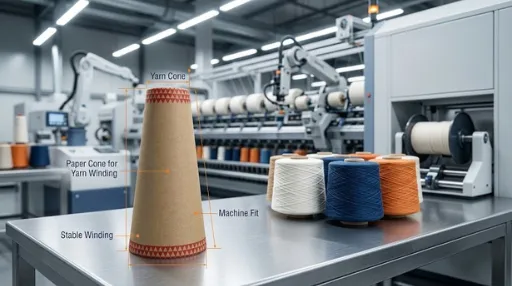
The surface finish of a paper cone is the first mechanical interface between the cone and your yarn. It governs how reliably the first layers of yarn grip the cone body, how stable the package build is through the winding cycle, and whether the auto-doffer can start each new cone without manual intervention.
Specify the wrong finish for your yarn type and you will see it in your stop rate within the first shift. Specify the right finish and it becomes invisible — the machine runs, the packages build cleanly, and nobody thinks about the cone.
This guide explains the three surface finishes available for auto-machine paper cones — smooth, velvet, and embossed — when each is appropriate, and how to choose correctly for your yarn type and winding application.
Why Surface Finish Matters: The First-Layer Problem
When a new cone is loaded onto an autoconer winding head and the yarn tail is caught by the auto-doffer, the first 3-5 layers of yarn being wound are in a vulnerable state. The yarn is moving fast, the tension is building, and the only thing holding the wound layers in place is friction between the yarn and the cone surface.
If that friction is insufficient — because the yarn surface is smooth, because the cone surface is too smooth, or because both are smooth — the early layers slip. When layers slip, the package geometry deforms from the first wind. The traverse pattern shifts. The package builds uneven layers on top of an already-unstable base. The tension sensor flags a fault. The machine stops.
This is the first-layer problem. It is not a machine problem. It is a friction mismatch between the yarn surface and the cone surface. Surface finish is the specification that controls it.
Smooth Finish: When to Use It
Smooth finish — also called plain finish — is the standard, unmodified paper surface of the finished cone. The paper has a natural slight texture from the kraft manufacturing process but no additional surface treatment has been applied.
When smooth finish is appropriate:
Smooth finish is appropriate for natural fibre yarns — primarily cotton, but also wool, linen, and most natural-fibre blends. Natural fibres have microscopic surface scales and fibre protrusions that create adequate friction against a smooth paper surface. The first layers of ring-spun cotton yarn on a smooth-finish cone grip reliably without slippage in standard winding conditions.
Smooth finish is also appropriate for coarser count synthetic yarns where the twist level is high enough that the yarn's surface texture — even for an inherently smooth fibre like polyester — creates sufficient friction through yarn-to-cone contact pressure.
When smooth finish is not appropriate:
Smooth finish is not appropriate for fine-count or filament synthetic yarns — polyester FDY, nylon, polypropylene, acrylic, and similar fibres where the yarn surface is genuinely smooth and the contact friction against smooth paper is insufficient for reliable first-layer grip.
It is also not appropriate in high-speed winding applications above 1,600 m/min for any yarn type where the high winding velocity reduces the contact time between yarn and cone surface on each traverse — which in turn reduces the effective friction available to stabilise early layers.
Velvet Finish: When to Use It
Velvet finish — also called rough finish, anti-slip finish, or sandpaper finish — is a controlled surface treatment applied to the cone during the manufacturing process. The result is a uniformly rough texture across the cone body that significantly increases the friction coefficient between the cone surface and the first yarn layers.
The texture is fine enough not to damage yarn — it does not abrade or catch yarn fibres — but coarse enough to provide a reliable grip on even the smoothest synthetic yarn surface.
When velvet finish is required:
Velvet finish is required for all fine-count synthetic yarns — polyester ring-spun or FDY, nylon 6 and nylon 66, polypropylene, acrylic, and viscose staple fibre with low twist levels. These yarns have insufficient surface friction against smooth paper to maintain stable first-layer grip.
Velvet finish is also recommended for:
High-speed winding above 1,600 m/min with any yarn type, where the contact-time reduction makes even moderately good friction levels insufficient.
Compact-spun yarns, where the compaction process smooths the yarn surface relative to conventional ring-spun yarn of the same count.
Technical yarns used in performance textiles, automotive fabrics, or medical textiles, where the yarn specification prioritises surface uniformity and inherently reduces friction with standard paper surfaces.
Fine-count cotton above Ne 60s, where the yarn is fine enough that the individual fibre contacts with the cone surface are fewer and the aggregate friction is lower than for coarser counts.
What velvet finish does not do:
Velvet finish does not affect cone geometry, weight, taper angle, or burst strength. It is a surface-only treatment. It does not damage yarn — a properly applied velvet finish creates friction through surface texture, not through abrasion. If you see yarn fibre damage on the first layers of a package wound on velvet-finish cones, the issue is the velvet texture specification being too coarse — this is a supplier quality issue, not a reason to revert to smooth finish for synthetic yarn.
Embossed Finish: The Specialist Option
Embossed finish is a surface pattern — typically a regular grid, diamond, or diagonal line pattern — pressed or printed into the cone surface during manufacture. It creates raised and recessed zones across the cone body.
Embossed finish is less commonly specified than smooth or velvet. Its primary applications are:
Yarn identification and count coding: Some mills use a specific emboss pattern on cones designated for particular yarn counts or styles, providing a tactile identification method in addition to any printed markings.
High-adhesion specialty applications: For very specific technical yarn types where neither smooth nor velvet provides the right friction profile, an embossed pattern can be engineered to provide a predictable, consistent grip geometry. This is rare in standard spinning mill applications.
OEM or branded cone requirements: Some downstream customers specify an embossed pattern as a quality or origin identifier on packaged yarn cones.
For the vast majority of spinning mill applications, embossed finish is not necessary. The choice is almost always between smooth and velvet based on yarn type and winding speed.
The Decision Matrix: Surface Finish by Application
Cotton ring-spun yarn, Ne 20s-60s, standard autoconer speed: Smooth finish.
Cotton ring-spun yarn, Ne 60s+, high-speed autoconer (above 1,600 m/min): Velvet finish.
Compact-spun cotton, any count: Velvet finish.
Polyester ring-spun yarn: Velvet finish, always.
Polyester FDY or filament yarn: Velvet finish, always.
Nylon 6 / Nylon 66: Velvet finish, always.
Polypropylene yarn: Velvet finish, always.
Acrylic yarn: Velvet finish, always.
Viscose/modal yarn, standard count: Smooth finish is often sufficient. Trial before committing — viscose surface properties vary by production process.
Cotton-polyester blend (above 30% polyester content): Velvet finish.
Cotton-polyester blend (below 30% polyester content): Smooth finish is typically adequate; trial if stop rate is elevated.
Wool ring-spun yarn: Smooth finish. Wool fibre scale structure provides strong surface friction.
Technical yarns (automotive, medical, industrial textiles): Velvet finish as default; confirm with yarn surface characterisation data.
Open-end (OE/rotor) spun yarn, cotton dominant: Smooth finish. OE yarn surface is slightly more hairy than ring-spun and provides adequate friction on smooth cones.
How to Identify the Finish on Your Current Cones
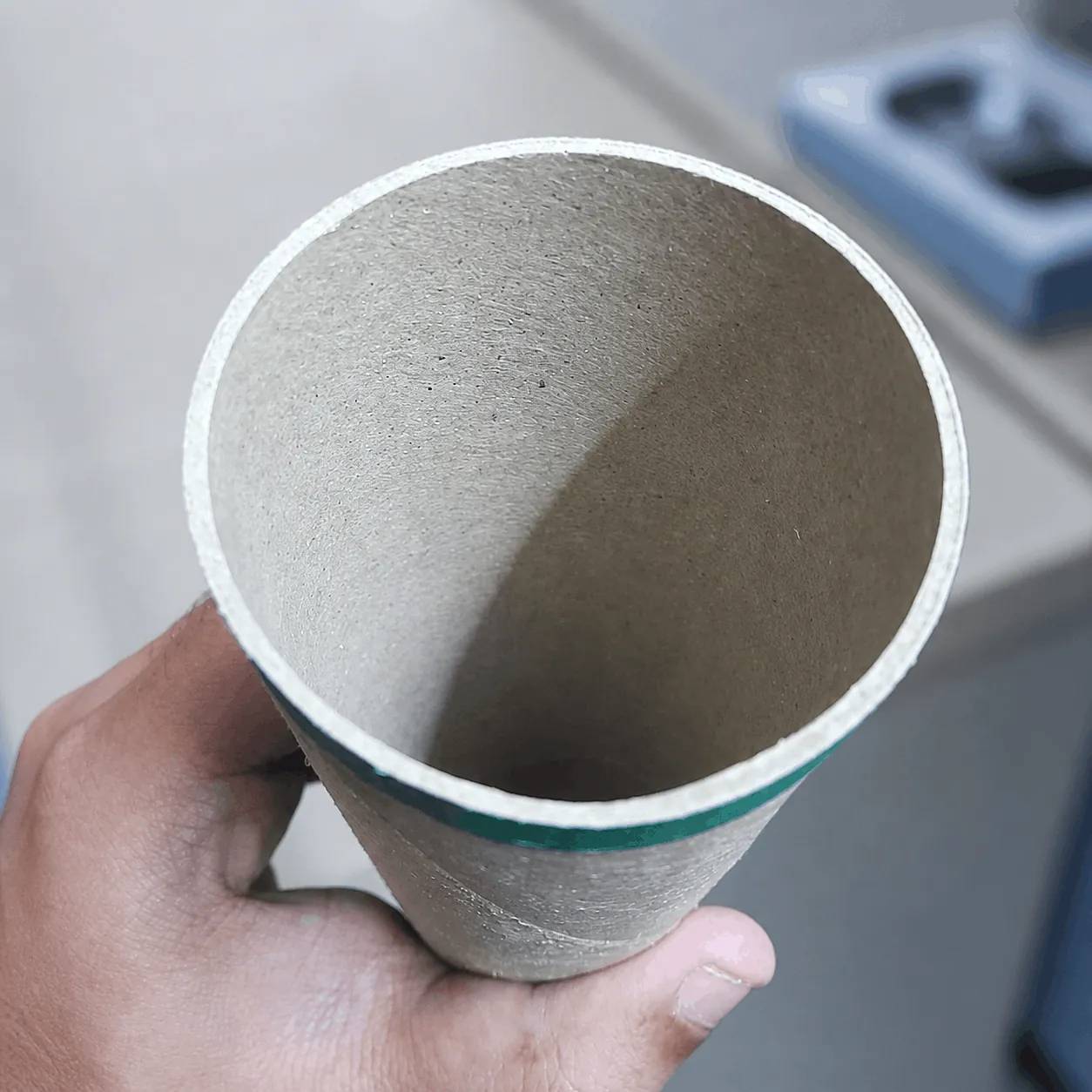
If you are unsure what finish your current cone supplier is providing, run a simple fingertip test: drag your fingertip slowly along the cone body from nose to base.
A smooth-finish cone feels like smooth kraft paper — clean, slightly cool, with very little surface resistance.
A velvet-finish cone feels noticeably rougher — like fine sandpaper or a matte textured surface. There should be a clear tactile difference between your fingertip moving across the cone and across a standard cardboard box.
An embossed cone has a regular raised pattern that is both visually visible and tactilely distinct.
If your fingertip test reveals that cones labelled as velvet finish feel only marginally rougher than smooth, you may be receiving an under-textured velvet finish — which will underperform on synthetic yarn applications. Request a sample from a different production batch or a different supplier and compare.
What Happens When the Wrong Finish Is Specified
Smooth finish used for synthetic yarn: First-layer slippage. Package telescopes from the base. The traverse loses geometry. Tension sensor flags a fault on the first few metres. Manual re-thread required. If the problem is not diagnosed as a finish mismatch, the maintenance team will spend time adjusting tension, checking the splicer, and inspecting the clearer — none of which will fix a finish mismatch.
Velvet finish used for natural fibre yarn: In most cases, this causes no performance problem — velvet finish is adequate for natural fibre applications. The consequence is a slightly higher per-piece cone cost than necessary if smooth finish would have performed equally well.
Velvet finish texture too coarse (supplier quality issue): Yarn fibre damage on early package layers. Increased yarn hairiness measured by Uster tester on the wound package. Higher clearer cuts on the yarn clearer in the downstream process. This is a supplier quality control failure, not a specification error — address with the supplier.
Frequently Asked Questions
Is velvet finish available as standard or does it need to be ordered specially? Velvet finish is a standard product option at most reputable paper cone manufacturers — it does not require special tooling or minimum order upgrades. Confirm availability when requesting a quotation.
Does velvet finish affect cone weight or burst strength? No. The velvet surface treatment is applied to the cone surface only and does not change the cone's structural paper weight or burst strength. A 40g velvet-finish cone has the same structural performance as a 40g smooth-finish cone of the same specification.
Can we switch from smooth to velvet mid-season without a machine trial? For synthetic yarn applications where you are currently experiencing first-layer slippage with smooth cones, switching to velvet is the correct fix — but run a 200-500 piece machine trial first to confirm the velvet texture grade is appropriate for your specific yarn type before committing to a full order.
Does Aziz Packaging supply both smooth and velvet finish in the same order? Yes. Alishan 5°57′ and Glass 4°20′ paper cones are available in both smooth and velvet finish within a single order — specify the finish for each line item on the proforma invoice. Note that the two finish types should be stored separately and clearly labeled to avoid mix-ups on the winding floor.
The Alishan 5°57′ auto-machine paper cone and Glass 4°20′ paper cone from Aziz Packaging Limited are available in both smooth and velvet surface finish. Contact us to specify the right finish for your yarn type, or request a trial sample of each finish for comparison on your machine.
[Request Finish Comparison Samples →] [Read: Paper Cone Weight and GSM Guide →] [Read: The 2026 Paper Cone Buyer's Checklist →] [Contact Us for a Quote →]