For product and order context, see our paper cones for spinning mills. Use this guide to prepare requirements for review; final acceptance follows your approved drawing and mill trial.
Inspect received stock before a production trial
Check carton condition and lot identification. Look for crushed rims, split layers, moisture signs, deformation and contamination. Keep suspect stock identifiable and record photographs and sample references. Compare dimensions against the agreed drawing, not an assumed tolerance from another supplier.
Damaged or crushed rims
A crushed or dented rim at the nose or base usually points to a packing or handling issue rather than a manufacturing defect — check whether the damage is concentrated on cones from the top or edge of the carton, which suggests transit crushing, versus damage spread evenly through the lot, which suggests a forming or handling issue before packing. A rim that's out of round (rather than simply crushed) can prevent correct seating on the spindle or automatic insertion arm regardless of cause, so it should be checked and quantified separately from cosmetic damage that doesn't affect fit.
Dimensional differences from the approved drawing
Measure at the same positions every time — nose, mid-body and base, on multiple cones per lot, not a single spot-check. A dimension that's consistently off across the whole lot points to a tooling or process drift at the supplier; a dimension that varies widely cone-to-cone within the same lot points to a process-control issue, which is a different (and often more serious) problem than a small consistent offset, since it means you can't predict how the next cone in the batch will behave from the ones you've already checked.
Surface finish problems
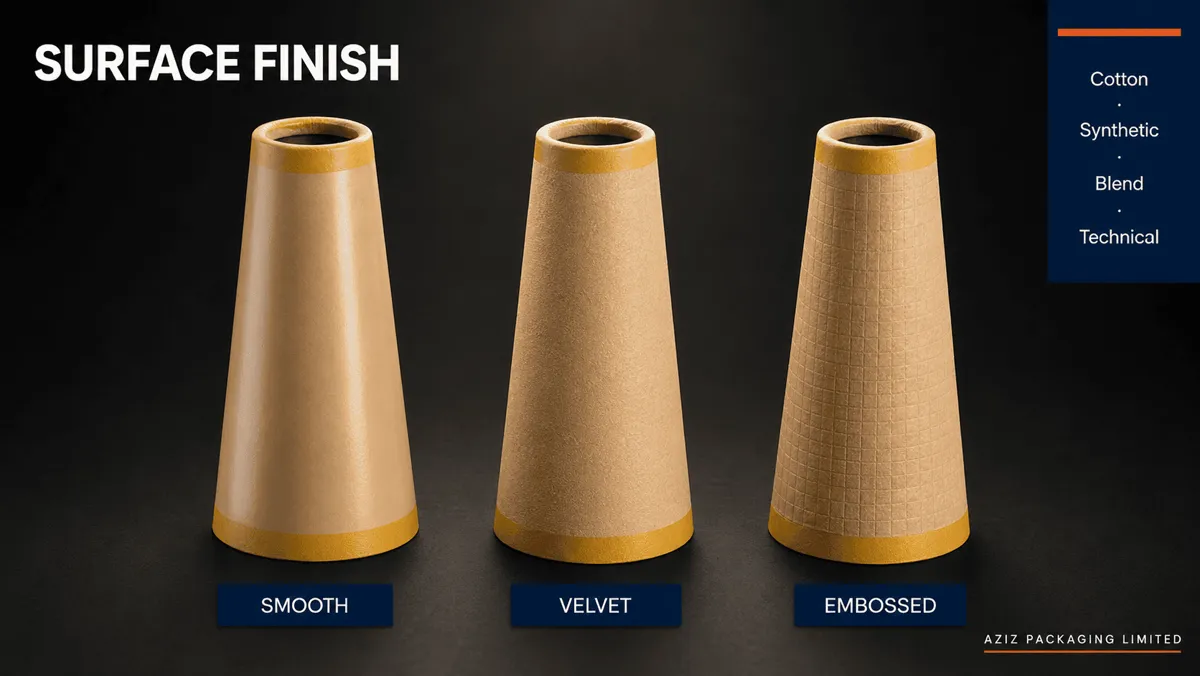
A finish issue shows up as inconsistent grip on the first wound layers — some cones in a lot hold the yarn tail cleanly, others slip. Before treating this as a supplier defect, confirm the finish actually matches what was ordered (smooth, velvet or embossed) and that it was trialled against the yarn type actually running on your machine — a finish that performs correctly for one yarn count or fibre type can still slip on another, which is a specification mismatch rather than a quality defect.
Packing condition on arrival
Note whether cartons show signs of moisture exposure, crushing from stacking, or shifting inside the box during transit — each points to a different stage in the supply chain (storage, loading, or in-transit handling) and a different party to raise it with. Photograph the carton exterior before opening it, then the contents as found, so the sequence of handling is documented rather than inferred after the fact.
Connect observations to the winding setup
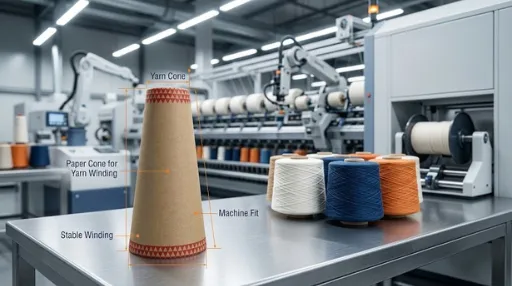
Starting slippage, vibration, package instability or doffing problems may involve the cone, yarn, holder or machine settings. Record the machine/head and operating conditions. Use the accepted reference in a controlled comparison and avoid changing several variables at the same time — swapping the cone and the yarn lot together in the same trial tells you nothing about which one caused the change you observe.
Prepare a useful supplier review
- Order and lot reference, approved drawing and sample revision.
- Measurement method, instruments, positions and individual readings — not just a summary pass/fail.
- Photographs of packaging, rims, inner wall and affected areas, taken before and after opening the carton.
- Yarn, settings and trial observations, including where in the cycle the issue appears (first layers, mid-package, doffing).
- Agreed acceptance limits and the corrective action requested, stated specifically rather than as a general complaint.
When it's a spec mismatch, not a quality defect
Not every winding-floor problem traced back to the cone is a manufacturing fault. A cone built exactly to an approved drawing can still cause problems if the drawing itself doesn't match the machine it's being used on — a taper, notch, or finish that was correct for one winder but got carried over to a different model without re-confirming. Before opening a supplier claim, check the drawing against the actual machine's manual, not just against what was ordered last time.
Prevent recurrence on repeat orders
Approve any revised specification before production and keep the accepted reference. Compare multiple received lots using the agreed inspection plan, and track results over successive orders rather than judging each lot in isolation — a slow drift across several orders is often visible before any single lot fails outright. The incoming QC checklist supports this review; the troubleshooting guide covers operating symptoms in more depth.
Send your exact winding-machine model, reference cone or drawing, taper, finish, quantity and destination through our sample and quotation form. Include any special inspection or packing requirement so it can be confirmed in writing.