Short answer: paper cones used for winding textile yarn are classified under HS subheading 4822.10. National tariffs add their own digits: 48221000 (4822 10 00) in India's HSN and the EU's Combined Nomenclature, 4822.1000 in Pakistan's PCT and 4822.10.00.00 in the US HTS. The duty depends on the importing country, the importer and the origin of the goods, so the table below links each figure to the official tariff it comes from.
What HS 4822.10 covers
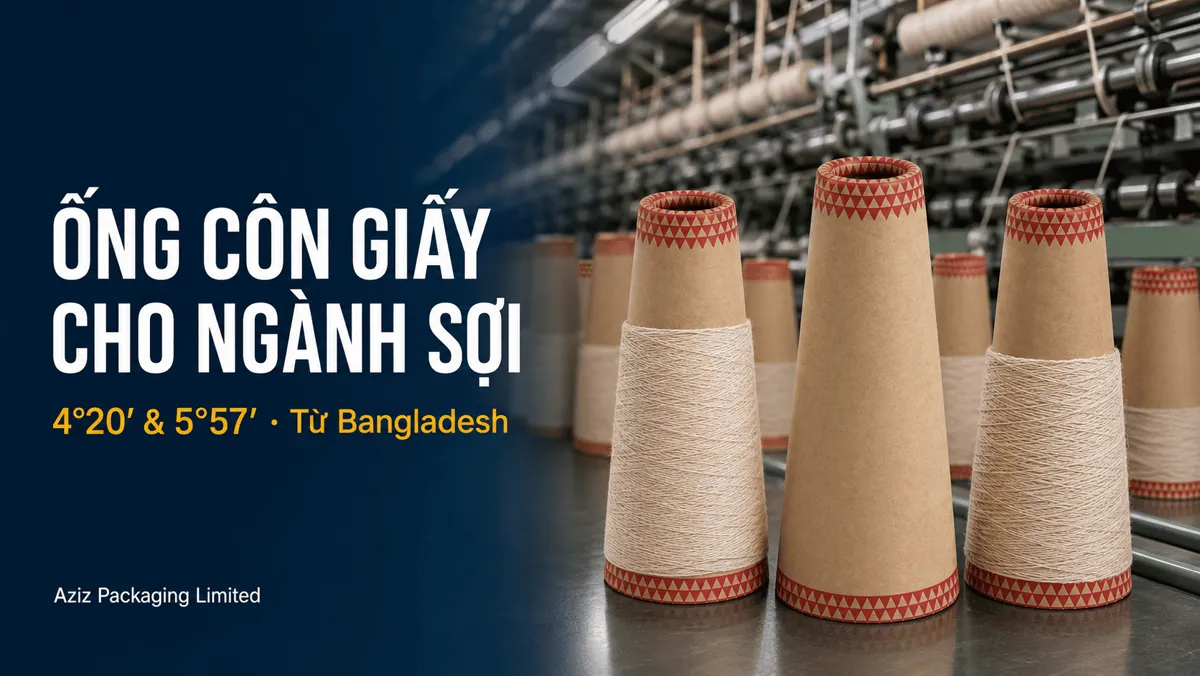
Heading 4822 covers "bobbins, spools, cops and similar supports of paper pulp, paper or paperboard (whether or not perforated or hardened)". Subheading 4822.10 is the part of that heading "of a kind used for winding textile yarn" (UN Statistics Division, HS classification detail). Kraft paper yarn cones in the 4°20′ and 5°57′ taper families are this product. Aziz Packaging ships its paper cones from Bangladesh under HS 4822.10.00.
Paper cone tariff codes and import duty by country
Checked on 28 September 2026. A "published duty" is the general customs duty in the official schedule named in the source column. It does not include VAT, sales tax, surcharges or other levies, and a preferential rate may replace it if the shipment qualifies.
| Market | National code | Published duty | Official source | What to check |
|---|---|---|---|---|
| Pakistan | PCT 4822.1000 | 15% customs duty | Pakistan Customs Tariff FY 2026-27 (FBR) | Additional customs duty, regulatory duty, sales tax and withholding tax are assessed separately. Ask whether a SAFTA concession applies. |
| India | 4822 10 00 (HSN 48221000) | Look up the current basic customs duty, Social Welfare Surcharge and IGST | CBIC customs tariff and ICEGATE | Under SAFTA, India gives least developed country members, including Bangladesh, duty-free access on all but 25 sensitive tariff lines (Notification No. 99/2011-Customs). A SAFTA certificate of origin and the rules of origin apply. |
| United States | HTS 4822.10.00.00 | General (MFN) rate: Free | USITC Harmonized Tariff Schedule | Additional duties on goods from particular countries can apply on top of the general rate. Check current US Customs guidance for Bangladesh-origin goods. |
| European Union | CN 4822 10 00 | Check TARIC for the import date | EU TARIC | Bangladesh-origin goods can qualify for duty-free access under the EU's Everything But Arms arrangement while Bangladesh holds LDC status. The exporter's REX origin statement is required. |
| Bangladesh | 4822.10.00 | Not applicable to local purchases | Bangladesh Customs duty calculator | Mills in Bangladesh buy locally, so no import duty arises. The code is used on export documents. |
| Indonesia | 4822.10 plus national digits (BTKI) | Check the current BTKI rate | Directorate General of Customs and Excise | Confirm the national line and any preference available on Bangladesh-origin goods. |
| Turkey | 4822.10 plus national digits (GTİP) | Check the Turkish Customs Tariff | Ministry of Trade | Confirm customs duty, any additional duty and VAT for the origin country. |
| Vietnam | 4822.10 plus national digits | Check the current import tariff | Vietnam Customs | Confirm the national line, VAT and any preference. |
| Ethiopia and East Africa | 4822.10 plus national digits | Check the national tariff | Ethiopian Customs Commission, or the national customs authority in Kenya, Tanzania or Uganda | Confirm duty, excise, VAT and withholding taxes with your clearing agent. |
Bangladesh's LDC status: the SAFTA and EU preferences above depend on Bangladesh's least developed country status. Graduation was scheduled for 24 November 2026, and Bangladesh has asked the UN to extend the preparatory period to 2029. Confirm the position on your import date before relying on a preference.
Codes for related products
Searches for "cone HS code" often mean different goods. These are the ones buyers most often confuse:
| What you are classifying | HS code | Note |
|---|---|---|
| Paper cones, tubes, bobbins and cops for winding textile yarn | 4822.10 | This product |
| Paper cores and tubes for other uses, such as paper, film or tape rolls | 4822.90 | "Other" supports of paper or paperboard |
| Plastic cones, bobbins and spools | 3923.40 | Spools, cops, bobbins and similar supports of plastics |
| Yarn sold wound on cones | Classified as the yarn, for example cotton yarn in Chapter 52 | A cone normally used to pack the yarn is classified with the yarn (General Interpretative Rule 5(b)) |
| Machines that make paper cones | Heading 8441 | Machinery for making up paper or paperboard; the subheading depends on the machine |
Build the landed cost line by line
Keep each cost separate so the broker can apply the right base to each tax: goods value, freight, insurance, customs duty, each other duty or tax, broker and port charges, and inland delivery. Percentages are often calculated on different bases, so they cannot simply be added together. Our paper cone HS code and import cost guide lists what each line needs, and the FOB Chattogram export terms page explains which costs sit with the buyer.
Questions for your customs broker
- Which national tariff line applies to kraft paper cones for yarn winding?
- Which duties, taxes and surcharges apply to this importer and shipment, and on what value?
- Is a preference available for Bangladesh-origin goods, and which origin certificate or statement is needed?
- Which invoice, packing list, transport and origin documents are required?
- Which port, handling and broker charges fall outside the taxes?
Documents we provide
Each export shipment is invoiced under HS 4822.10.00 with the commercial invoice, packing list and transport documents agreed in the quotation. Tell us which certificate of origin or origin statement your broker needs when you ask for a quote, so it can be arranged before production.
Send your winding-machine model, reference cone or drawing, taper, finish, quantity and destination port through our sample and quotation form.
Frequently asked questions
What is the HS code for paper cones?
Paper cones used for winding textile yarn are classified under HS subheading 4822.10: bobbins, spools, cops and similar supports of paper pulp, paper or paperboard, of a kind used for winding textile yarn. National tariffs extend it, for example to 4822.10.00 or 48221000.
What is the HSN code for paper cones in India?
India classifies paper cones for yarn winding under tariff item 4822 10 00, often written as HSN 48221000. Check the current basic customs duty, surcharge and IGST in the CBIC tariff or ICEGATE on your import date.
What is the import duty on paper cones in Pakistan?
The Pakistan Customs Tariff for FY 2026-27 lists PCT 4822.1000 at 15% customs duty. Additional customs duty, regulatory duty, sales tax and withholding tax are assessed separately.
Is yarn on cones classified under HS 4822?
No. Yarn sold wound on cones is classified as the yarn, for example cotton yarn in Chapter 52. A cone that is normal packing for the yarn is classified with the yarn under General Interpretative Rule 5(b).