Every year, procurement managers in Vietnam, Turkey, Egypt, Germany, and the United States compare FOB price quotations from paper cone suppliers in Bangladesh, India, and Pakistan — and make sourcing decisions based on that comparison alone.
That is a mistake.
The FOB price is the price of the cone at the port of export. What your mill actually pays is the landed cost — the FOB price plus ocean freight plus marine insurance plus import duty plus destination port charges. And those additions can change the competitive ranking between suppliers dramatically depending on where your mill is located.
This guide builds the full landed-cost comparison for paper cones sourced from Chittagong (Bangladesh), Mumbai or Nhava Sheva (India), and Karachi (Pakistan) — to six of the world's most important textile import markets.
The Three Origins: A Brief Overview
FOB Chittagong (Bangladesh)
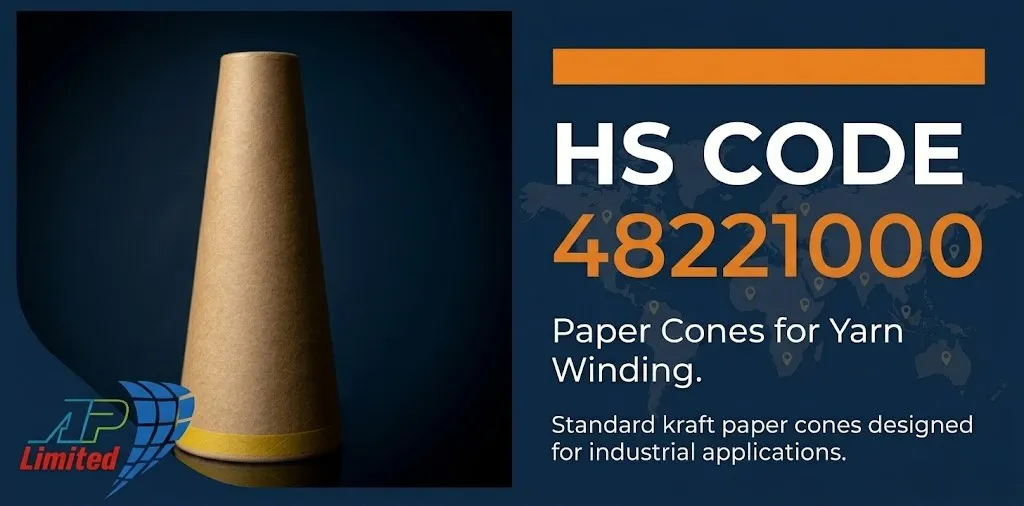
Chittagong Port — officially Chattogram Port — is Bangladesh's primary international seaport and one of the busiest ports in South Asia by container volume. It handles the overwhelming majority of Bangladesh's export cargo. For paper cone exports under HSN 48221000, FOB Chittagong is the standard delivery basis.
Bangladesh-origin goods benefit from GSP/EBA preferential duty rates in the EU, UK, Canada, Japan, and Australia — potentially reducing or eliminating import duty on arrival. This duty advantage is built into the landed-cost calculation below.
FOB Mumbai / Nhava Sheva (India)
India exports the largest volume of paper cones of any country in the world. Most Indian paper cone manufacturers are located in Coimbatore, Ludhiana, Ahmedabad, or Surat — all of which feed to either Nhava Sheva (near Mumbai, serving west-coast and Gujarat manufacturing) or Chennai port (serving Coimbatore and south-Indian mills).
For this comparison, FOB Nhava Sheva is used as the Indian benchmark — it is the most widely used Indian export port for paper cones based on trade data.
FOB Karachi (Pakistan)
Pakistan's paper cone industry is concentrated in Karachi, Lahore, and Faisalabad. Most export shipments clear through Karachi port. Pakistani suppliers are most competitive in Gulf Cooperation Council markets and certain African corridors where Karachi has natural freight advantages.
Transit Times: The Lead-Time Variable
Before the cost comparison, transit times — the number of days from FOB loading to arrival at the destination port — matter because they affect your inventory planning and reorder cycle.
To Vietnam (Hai Phong / Cat Lai):
- From Chittagong: 7-10 days
- From Nhava Sheva: 9-14 days
- From Karachi: 12-18 days
Bangladesh has a meaningful transit-time advantage to Vietnam, which has become one of the world's fastest-growing textile manufacturing markets.
To Turkey (Mersin / Ambarlı):
- From Chittagong: 18-22 days
- From Nhava Sheva: 16-22 days
- From Karachi: 14-20 days
Pakistan has a slight transit advantage to Turkey, while Bangladesh and India are broadly comparable.
To Egypt (Alexandria / Port Said):
- From Chittagong: 16-20 days
- From Nhava Sheva: 12-16 days
- From Karachi: 10-14 days
India and Pakistan have a clear transit advantage over Bangladesh to Egypt — the shorter sailing distance through the Red Sea is the primary factor.
To Germany (Hamburg):
- From Chittagong: 22-28 days
- From Nhava Sheva: 20-26 days
- From Karachi: 22-28 days
All three origins are broadly comparable to Northern European ports.
To USA (Los Angeles / Charleston):
- From Chittagong: 18-24 days (via Colombo or Singapore transhipment)
- From Nhava Sheva: 22-28 days (direct east coast) or 16-20 days (west coast via Suez)
- From Karachi: 22-28 days (east coast)
To Indonesia (Tanjung Priok, Jakarta):
- From Chittagong: 9-14 days
- From Nhava Sheva: 12-16 days
- From Karachi: 16-22 days
Bangladesh has a strong transit advantage to Indonesia.
Ocean Freight Costs: What LCL Shipping Actually Costs per 100,000 Cones
100,000 pieces of 170mm, 40-42g paper cones pack into approximately 8-10 CBM at approximately 5,000-5,500 kg gross weight. This is a standard LCL (Less than Container Load) shipment.
Ocean freight rates fluctuate with global container market conditions — the figures below are representative benchmarks for mid-2026 market conditions and should be validated with your freight forwarder before using in a live landed-cost model.
To Vietnam (Hai Phong):
- LCL from Chittagong: approximately USD 380-480
- LCL from Nhava Sheva: approximately USD 420-520
- LCL from Karachi: approximately USD 480-600
To Turkey (Mersin):
- LCL from Chittagong: approximately USD 620-820
- LCL from Nhava Sheva: approximately USD 580-780
- LCL from Karachi: approximately USD 540-720
To Egypt (Alexandria):
- LCL from Chittagong: approximately USD 700-900
- LCL from Nhava Sheva: approximately USD 580-780
- LCL from Karachi: approximately USD 500-700
To Germany (Hamburg):
- LCL from Chittagong: approximately USD 950-1,250
- LCL from Nhava Sheva: approximately USD 900-1,200
- LCL from Karachi: approximately USD 1,000-1,300
To USA (Los Angeles):
- LCL from Chittagong: approximately USD 1,000-1,400
- LCL from Nhava Sheva: approximately USD 1,100-1,500
- LCL from Karachi: approximately USD 1,100-1,500
To Indonesia (Tanjung Priok):
- LCL from Chittagong: approximately USD 350-450
- LCL from Nhava Sheva: approximately USD 400-520
- LCL from Karachi: approximately USD 560-700
The Import Duty Variable: Where Bangladesh's Structural Advantage Lives
This is the factor most often ignored in origin comparisons — and the one that most dramatically changes the landed-cost ranking.
Bangladesh is one of the world's least developed countries (LDC) and benefits from preferential trade arrangements that Indian and Pakistani exporters do not. For paper cones (HSN 48221000), the duty implications are:
European Union: Bangladesh 0% (EBA scheme) versus India 3.7% (MFN) and Pakistan 3.7% (MFN). On a CIF value of USD 4,000 for 100,000 cones, this is a duty saving of approximately USD 148 for Bangladesh over India or Pakistan origin. Over a year of four quarterly orders, that is nearly USD 600 in duty savings — before any FOB price differential.
United Kingdom: Bangladesh 0% (DCTS) versus India 3.7% (UK Global Tariff for HS 4822). Similar magnitude to the EU advantage.
Canada: Bangladesh benefits from Canada's LDC tariff treatment. India and Pakistan pay MFN duty.
Japan and Australia: Bangladesh benefits from LDC preferences in both markets.
Turkey: 0% MFN for all origins — duty is not a differentiator here.
USA: 0% for all origins — no duty advantage.
Vietnam: 20% MFN for all origins — no duty advantage between Bangladesh, India, and Pakistan.
Full Landed-Cost Comparison: Bangladesh vs India to Germany (100,000 pcs)
To make this concrete, here is a full landed-cost calculation for a 100,000-piece order of 5°57′, 170mm, 40g standard cones, delivered to Hamburg.
Bangladesh (Alishan 5°57′, FOB Chittagong):
- FOB price (estimate, mid-range): USD 3,800
- Ocean freight Chittagong to Hamburg (LCL benchmark): USD 1,100
- Marine insurance (0.3% CIF): USD 15
- CIF Hamburg: USD 4,915
- Import duty at 0% EBA: USD 0
- Destination handling: USD 200
- Total landed Hamburg: approximately USD 5,115
India (comparable spec, FOB Nhava Sheva):
- FOB price (estimate, competitive Indian supplier): USD 3,600
- Ocean freight Nhava Sheva to Hamburg (LCL benchmark): USD 1,050
- Marine insurance: USD 14
- CIF Hamburg: USD 4,664
- Import duty at 3.7% MFN: USD 173
- Destination handling: USD 200
- Total landed Hamburg: approximately USD 5,037
In this scenario, the Indian FOB price advantage of USD 200 per 100,000 pieces is largely offset by the import duty differential. The net landed-cost difference is approximately USD 78 — less than 0.08 cents per cone — in favour of Indian origin.
As the Bangladesh FOB price approaches the Indian FOB price (which is the case for well-established Bangladesh manufacturers), the EBA duty advantage tips the landed-cost balance clearly in favour of Bangladesh origin for EU-destination buyers.
The Practical Decision Framework
Use this framework to decide which origin makes commercial sense for your mill:
If you are in the EU, UK, Canada, Japan, or Australia: Run a full landed-cost comparison including the Bangladesh EBA/GSP duty advantage. Do not make a sourcing decision based on FOB price alone — the duty differential is material.
If you are in Vietnam or Indonesia: Bangladesh has a freight and transit advantage. Duty is equal across origins. Compare FOB prices directly — Bangladesh is increasingly competitive.
If you are in Turkey or Egypt: Freight rates are broadly similar between Bangladesh and India. Turkey has zero MFN duty for all origins. Egypt may offer GSP benefits for Bangladesh. Check current duty rates and compare full landed cost.
If you are in the USA: Zero duty for all origins. The decision is purely FOB price plus freight. Bangladesh and India are broadly competitive; the decision turns on quality, lead time, and supplier reliability.
If you are in the GCC (UAE, Saudi Arabia, Kuwait): Pakistan has a slight freight advantage from Karachi. India has a large installed supplier base in this corridor. Bangladesh is competitive on quality and price but may have a slight freight disadvantage. Run the numbers for your specific destination port.
Frequently Asked Questions
How often do ocean freight rates change? Container freight rates fluctuate weekly with global demand. The benchmarks in this guide reflect mid-2026 market conditions. Always obtain a live freight quotation from your forwarder before finalising a landed-cost comparison. The relative ranking of the three origins by freight cost is more stable than the absolute numbers.
Is there a risk of Bangladesh cone shipments being delayed at Chittagong port? Chittagong port has historically experienced congestion periods, particularly during peak garment export seasons (October-December). Build a 1-2 week buffer into lead times for Q4 orders. The port has made infrastructure investments in recent years that have reduced congestion; your freight forwarder will have current intelligence on berth availability.
Does the import duty calculation change if I use an LC versus TT payment? No. Import duty is assessed on the CIF value of the goods regardless of the payment method used between buyer and seller.
Can I mix origins within one shipment to compare quality? Yes — ordering a comparative batch of 50,000 pieces from Bangladesh and 50,000 pieces from India within the same quarter is a legitimate qualification strategy. Run both batches through your machine population and track stop rates, package quality, and dimensional conformance. The best quality-cost performer should win the full volume.
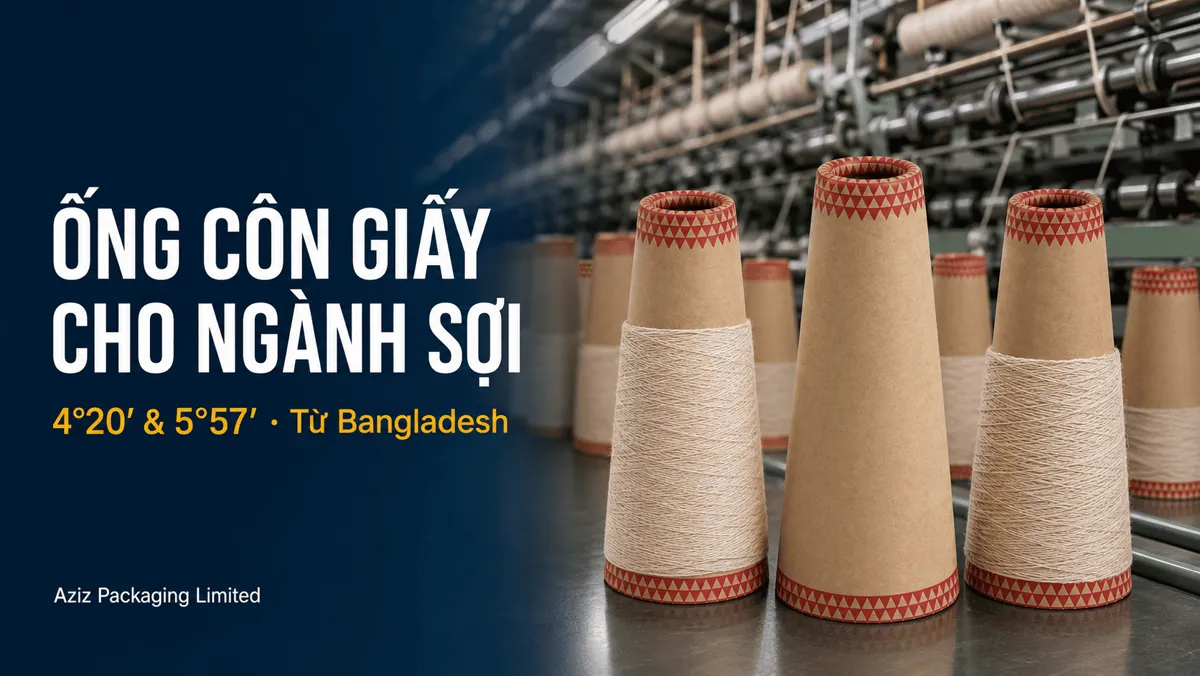
Aziz Packaging Limited exports Alishan 5°57′ and Glass 4°20′ paper cones FOB Chittagong with full documentation support including HSN 48221000, certificate of origin (for EBA/GSP claims), and proforma invoice in USD. Contact us for a current FOB quotation and freight estimate to your destination port.
[Request a FOB Chittagong Quote →] [Read: HSN Code 48221000 Import Duty Guide →] [Read: Paper Cone MOQ Explained →]